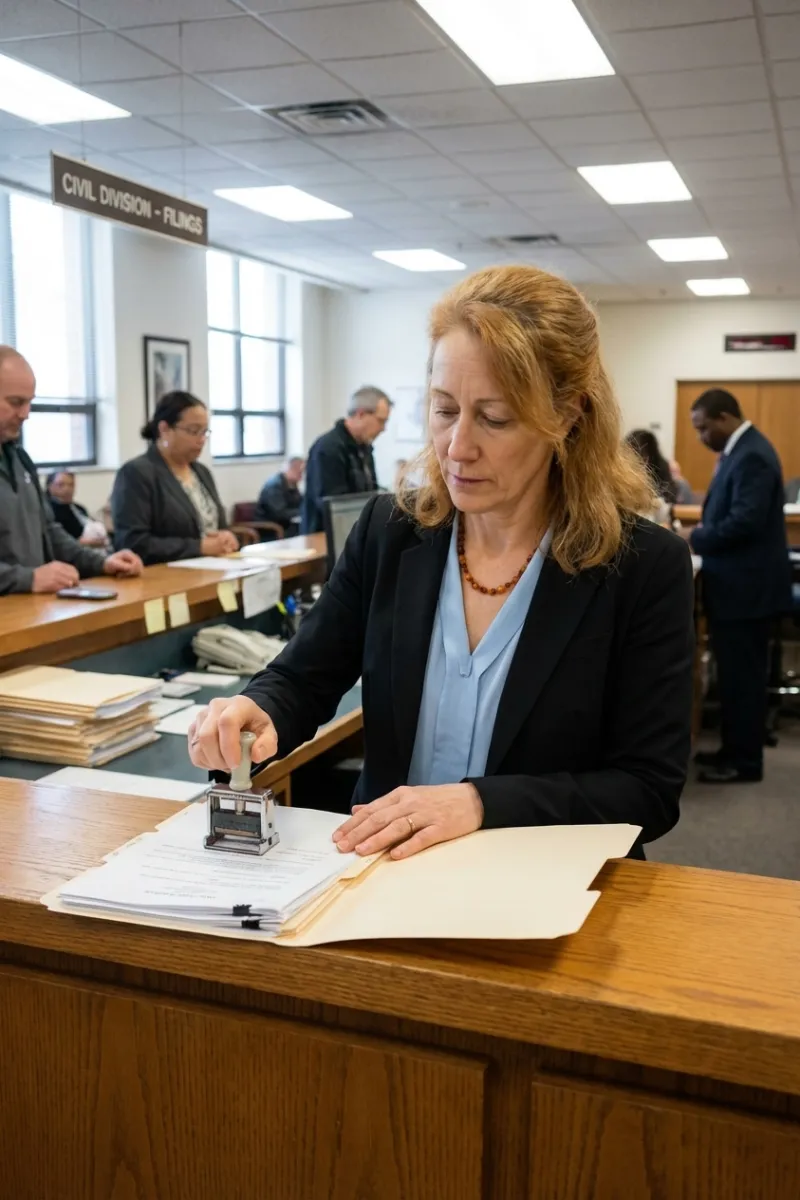
One Page, Six Weeks Lost: How a Careless Affidavit of Service Unraveled a Motion Practice Calendar
Photo: legal affidavit document on desk with pen and gavel, via thumbs.dreamstime.com
The motion was ready. The merits were strong. The defense had little to work with — until their attorney read the affidavit of service and found the crack that would consume the next six weeks of litigation.
It happens more often than most practitioners care to admit. The service itself may have been perfectly valid. The defendant may have been personally handed the summons in broad daylight. But if the paper trail documenting that moment is sloppy, the validity of the entire serve becomes an open question — and open questions in litigation cost time, money, and leverage.
The Scenario: A Serve That Worked, a Record That Didn't
Consider a commercial debt collection matter in a state trial court. The process server located the defendant at his place of business, effectuated personal delivery, and left with what he believed was a completed job. The affidavit he later submitted told a different story:
- The date of service was transposed — the affidavit read March 14, but the court's stamp on the summons showed service occurred on March 4.
- The description of the person served was vague to the point of uselessness — "adult male, approximately middle-aged" with no distinguishing detail, no height, no clothing description.
- The server's license or registration number was absent, a field left blank in a state that requires it.
- The address of service conflicted with the address listed on the summons, with no explanation offered.
None of these defects, standing alone, necessarily proved the service was invalid. Together, they gave the defendant's counsel everything needed to file a motion to quash — and gave the plaintiff's attorney a six-week detour through briefing, a hearing, and ultimately a voluntary re-service just to remove the doubt.
Defect by Defect: Why Each Line Mattered
The transposed date. Dates are the skeleton of any affidavit. When the sworn date of service contradicts other records in the file — a court stamp, a GPS log, a time-stamped photograph — opposing counsel will argue the affidavit is unreliable as a whole. Courts may tolerate scrivener's errors, but only when the surrounding documentation lets them reconstruct the truth. Here, it did not.
**The generic description." An affidavit that says "adult male" proves little. A description like "male, approximately 45 years old, 6'0", gray jacket, served at the reception desk of 1200 Main Street, Suite 300" corroborates itself. Specificity is not decoration; it is the evidentiary weight of the document.
The missing license number. In many jurisdictions, process servers must be registered, commissioned, or licensed, and the credential number belongs on the affidavit. Omitting it invites the argument that the server lacked authority — an argument that is tedious to rebut and unnecessary to invite.
The unexplained address discrepancy. A serve at an address different from the one on the summons is not fatal, but an unexplained discrepancy is. One sentence noting the defendant's registered business address or a correction of record resolves it. Silence manufactures doubt.
What a Bulletproof Affidavit Looks Like
Attorneys should treat every affidavit of service as a document that will be attacked, because in contested litigation it will be. The benchmark looks like this:
- Server's full legal name, license or registration number, and issuing authority
- Exact date and time of service, consistent with all supporting records
- Precise address of service, including suite or unit number
- A specific physical description of the person served and their relationship to the defendant, if not the defendant personally
- The method of service used, cited to the applicable rule of civil procedure
- Whether any attempt was preceded by failed attempts, with dates
- Exhibits where available: GPS coordinates, photographs, or body-camera stills
The last item deserves emphasis. The strongest affidavits no longer rest on memory alone. GPS-stamped routes and digital trails have become the standard of proof that thoughtful firms expect — and that skeptical courts increasingly welcome.
The Real Cost of "Good Enough"
The plaintiff in this scenario eventually re-served the defendant, re-filed, and proceeded. But the motion practice calendar slipped six weeks, the client absorbed avoidable fees, and opposing counsel gained a credibility argument that followed the case to settlement talks: if the plaintiff's records could not be trusted on something as simple as a date, what else was sloppy?
That is the true cost of a defective affidavit. Not the dismissal that sometimes follows, but the erosion of confidence — in the serve, in the record, and in the firm that produced it.
A Standard Worth Demanding
Attorneys evaluating process serving vendors should ask to see sample affidavits before the first referral, not after the first motion to quash. Ask whether GPS and timestamp data accompany every serve. Ask whether the affidavit cites the governing rule. Ask what happens when a field cannot be completed — because a professional provider explains, rather than leaves blank.
At A2Z Process Service, documentation is treated as the deliverable, not the afterthought. Every serve is supported by a rule-compliant affidavit, corroborating GPS and time records, and a review pass before anything reaches counsel. Because the difference between a serve that holds and a serve that collapses is usually just one page — written carefully or written carelessly.
The merits of your case deserve better than "approximately middle-aged."