Filed Before Five: Inside the High-Stakes Sprint from Law Office to Court Clerk
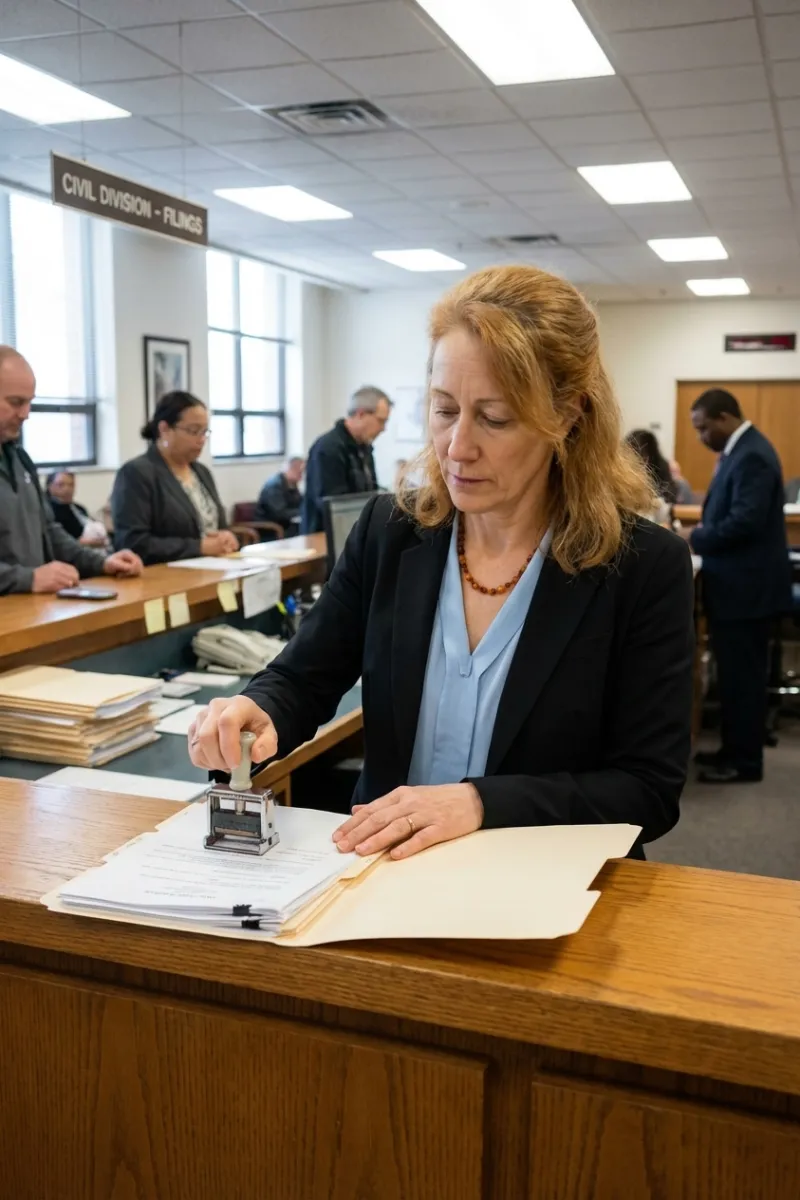
Photo: courthouse clerk counter filing documents professional, via usconstitution.net
At 2:47 p.m., the call comes in. A summons needs to be filed before the clerk's office closes at 5:00, the notary who usually handles the firm's affidavits left early, and opposing counsel has already noticed a hearing for Monday morning. For the attorney on the other end of the line, the situation feels like a crisis. For a professional filing runner, it's a Tuesday.
Court filing runs occupy a strange corner of the legal support world. Everyone in litigation depends on them, yet few outside the courthouse walls understand what the job actually involves. It is part logistics, part diplomacy, and part improvisational theater — performed daily in every county courthouse in America.
The Notary Problem Nobody Budgets For
Every filing begins with paperwork that must be sworn, signed, and sealed. That sounds simple until you consider the mechanics. An affidavit that is notarized incorrectly — a missing commission expiration date, a jurat used where an acknowledgment was required, a signature dated after the notarization — will bounce at the counter, and a bounced filing on a deadline day is not a paperwork problem. It's a malpractice problem.
Experienced filing services treat notarization as a gatekeeping step, not a formality. Before a document ever reaches a car, someone verifies that the notary's commission is current, that the venue language matches the county of filing, and that every exhibit referenced in the body of the document is actually attached. It is unglamorous work, and it is precisely the work that gets skipped when a paralegal is juggling three deadlines at once.
Every Clerk's Counter Has Its Own Personality
Ask a veteran court runner about filings and you will hear about counters, not courts. The rules of civil procedure are uniform on paper; the people enforcing them at the window are not.
One county clerk rejects any filing without a self-addressed stamped envelope, even though no rule requires it. Another insists on two-hole punches in the top of every document. In some jurisdictions, the runner who arrives at 4:55 p.m. with a correctly formatted stack gets stamped without a glance. In others, a missing case number suffix sends the whole package back to the car.
Professional runners keep mental — and often literal — notebooks of these quirks. Which clerk prefers filings sorted a particular way. Which courthouse has a second intake window that stays open later than the main one. Which counties accept courtesy copies and which treat them as clutter. This institutional memory cannot be downloaded; it accumulates over thousands of runs, and it is the single biggest reason attorneys hand filings to specialists rather than sending a staff member who visits the courthouse twice a year.
When the Document Comes Back Rejected
Rejection is a normal part of the process, not a failure. Statutory blanks left unfilled, formatting that drifted during a PDF conversion, a caption that doesn't match the court's docket — any of these can stop a filing cold.
The difference between an amateur and a professional shows in the next fifteen minutes. A runner from a full-service firm doesn't simply call the office and report the problem. They photograph the rejection stamp, call the drafting attorney with the specific defect, arrange for a corrected version by secure upload, locate the nearest notary, and get back in line — all while the clock runs. Some maintain standing relationships with local print shops and notaries near every courthouse they serve, precisely so a corrected document can be printed, sworn, and refiled within the same business day.
The Same-Day Docket Rush
Certain filings cannot wait for tomorrow, and the profession's calendar revolves around them. Temporary restraining orders, petitions filed on the eve of a statute of limitations expiration, emergency motions tied to a hearing the next morning — these runs carry the full weight of a client's matter on a single stamp.
On days like these, routing matters as much as speed. A runner covering multiple courthouses in one circuit will sequence stops by closing time, traffic patterns, and which clerks process expedited filings first. A seasoned professional knows that arriving at the wrong window can cost twenty minutes, and twenty minutes can be the difference between a filed petition and a dismissed case.
Why Attorneys Keep Handing Off the Keys
The economics are straightforward. An attorney's or paralegal's hour is worth far more than a filing fee plus a runner's charge. Every trip to the courthouse is an hour not spent on billable work, and every rejected document is a risk borne alone. Delegating the run transfers both the labor and the risk to a party equipped to absorb them — one with backup runners, county-by-county knowledge, and procedures built for the 4:47 p.m. emergency.
There is also a quieter benefit: continuity. When the same service handles a firm's filings, serves, and skip tracing, the courthouse knowledge lives in one place. The person who knows that a particular judge's division requires conformed copies also knows where the defendant in that case can be found on Thursday afternoons.
The Stamp Is Only the Beginning
A time-stamped filing is the visible end of an invisible process — one built on checklists, county lore, and a tolerance for counters that close without warning. The next time a docket entry appears with minutes to spare, it's worth remembering the choreography behind it: the notary found in a strip mall, the corrected exhibit printed at 4:20, the clerk who agreed to take one more filing before the lights went out.
That is the job. Done well, it looks like nothing happened at all.